
The Emotional Athlete
—
Emotion shapes how you move.
Movement shapes how you feel.
Movement shapes how you feel.
Emotion shapes how you move.
The Emotional Athlete
Towards a theory of emotion in movement
The Emotional Athlete is a research process aiming to build a comprehensive theory and practical pedagogy for emotions in sports performance and skill acquisition. Despite advances in motor learning theories, the role of affect in action and perception has not been taken as seriously as other aspects of action and perception. Research establishes emotional states as exerting a strong influence on an extremely wide range of motor learning relevant phenomena, from degrees of freedom to decision making to information seeking and encoding. Emotion, it is often argued, affects all aspects of life.
Ecological pioneer JJ Gibson was explicitly skeptical about the relevance of affect in action and perception. However, this leaves one of the dominant theories of motor learning science without a language to talk about one of the core aspects of the ecology of movement.
“The perception of what something affords should not be confused with the “coloring” of experience by needs and motives. Tastes and preferences fluctuate. Something that looks good today may look bad tomorrow but what it actually offers the observer will be the same.”
— JJ Gibson. Notes on affordances: Part V. The affordances of the environment.
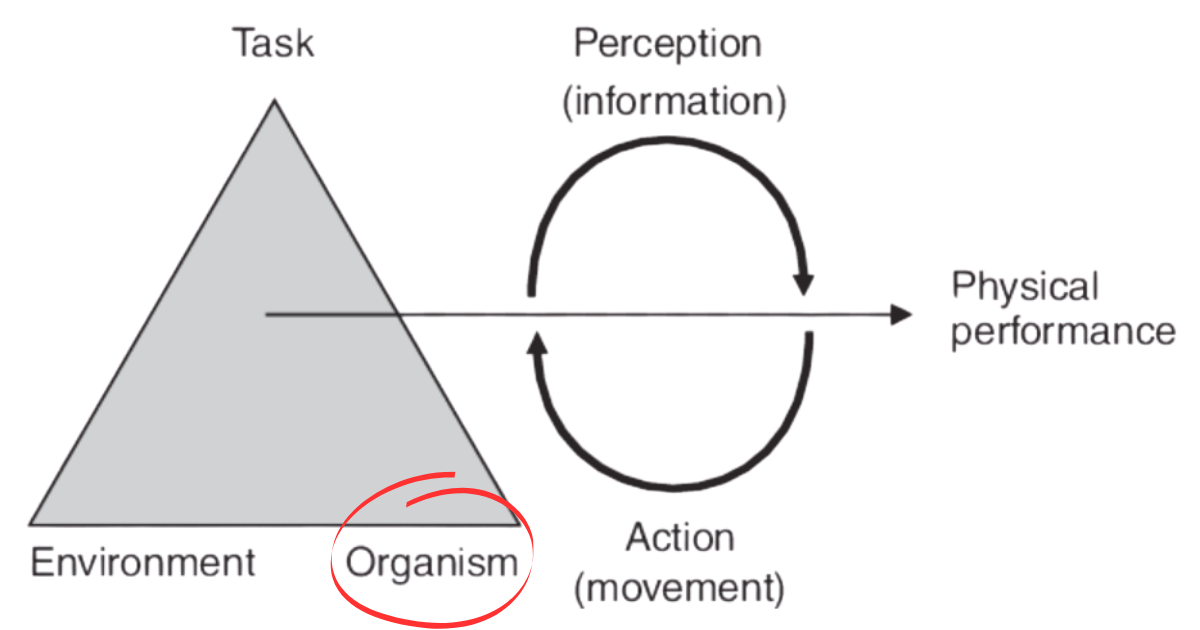
Because much of the theoretical research made on emotion comes from the field of predictive processing, there is a significant distance to cover between the ecological theories of direct perception and the predictive ideas around representationalism. In less jargon-filled words, understanding the brain as a computer allows us a high level of precision in talking about inner states as emerging from belief, trust and surprise. However, this theory struggles to explain the speed at which athletes are able to change their movement plans.
Enactivism offers a bridge, allowing us to consider the organism as both dependent on its constitutive relationships and yet direct in its interaction with the world. Those relationships may include what is described in the predictive processing literature, for example the imperative to minimise uncertainty.
I used Claude Opus to build an interactive game where you can see how emotions are formed by relationships: https://flynndisney.github.io/emotion-topography/index
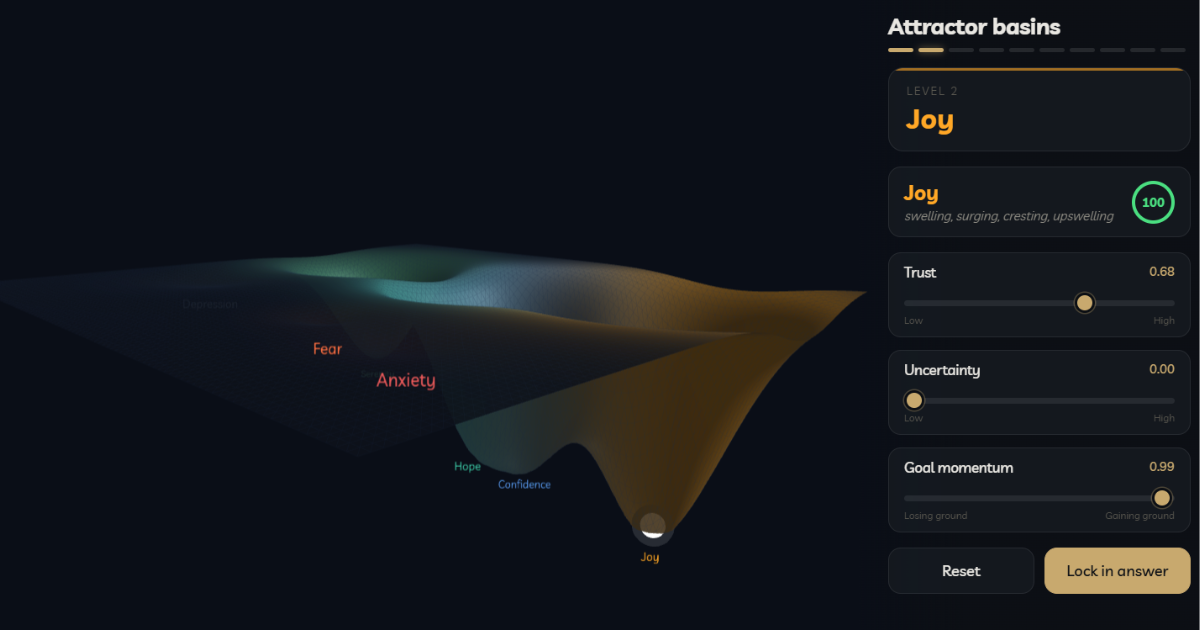
Furthermore, those relationships are enacted through emotions — states of variable valence and arousal that contribute towards particular patterns of action and perception. Whilst there is debate around whether emotions have innate circuitry or are culturally constructed, research demonstrates consistency between both bodily representations of emotional states and the action tendencies those states are associated with.
For example, joy is not only a good feeling, but provides an array of behavioural tendencies that are distinct from other emotional states. These tendencies, which include increases in exploration, cognitive flexibility and recovery from stress, all mirror the constitutive relationship that joy emanates from: what Mark Miller’s lab describes as getting a good grip around what one is concerned about.
What phenomena must also be explained by a good theory of emotion is the distinct motor properties of a given emotional state, for example the attitude of heaviness in depression or that of lightness in joy. Through the enactivist lens, these attitudes are easy to explain theoretically because there is no separation between how the organism is processing concern about their environment and their movement in that environment. They are inseparable sides of the same coin — just as music is not separable from the instrument or the player.
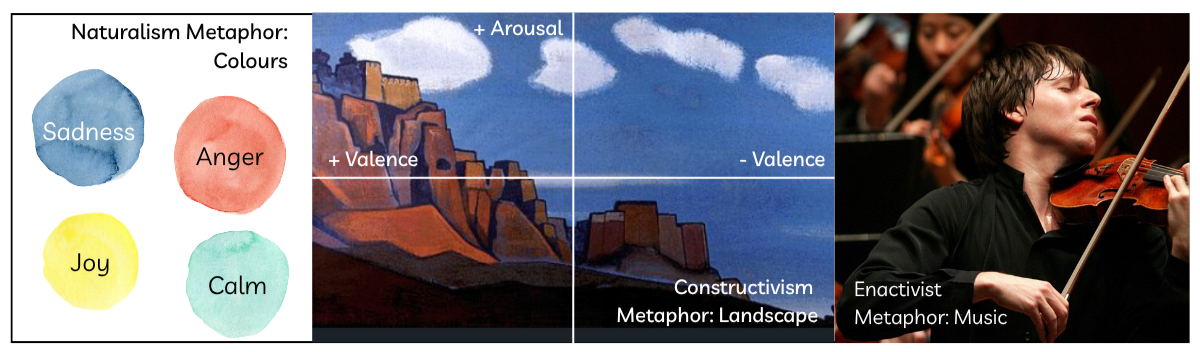
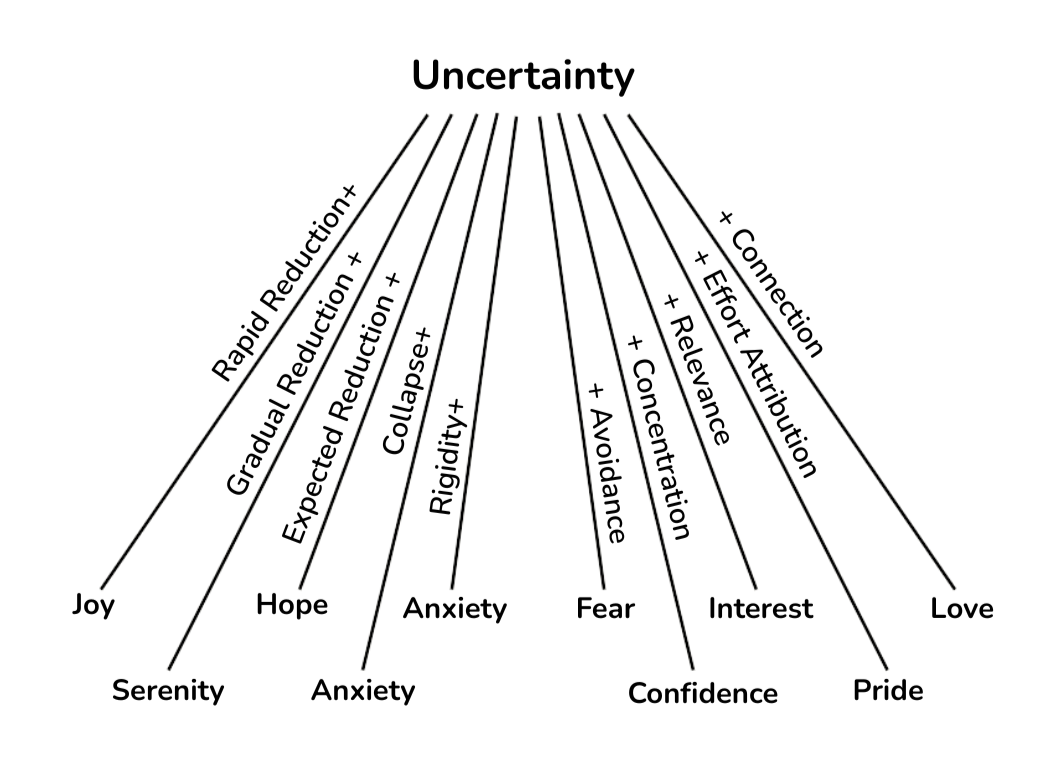
Recent work on the somato-cognitive action network provides a neurological basis for the coupling of goals, visceral modulation and bodily movement into distinct modes of action. Whilst the literature does not explicitly describe these as attitudes, this small liberty provides us with a way of thinking about how relationships to goals, self-regulatory movement of smooth musculature and movement of the skeletal musculature come together into the feeling tone of a particular emotional state.
Questions remain about the bi-directionality of these couplings. To what extent does a change in the organisation of my skeletal musculature or of my self-image affect the entirety of self? Through my work with the joy study, I have observed increase in emotional flexibility from participating in exercises that increase energisation and decrease tonic muscle tension, for example skipping, vocalising and engaging in particular kinds of meditation.
The potential for exploration here is profound, but presents a step beyond academic theory of action and perception into the realm of philosophy. Am I my emotions? What do I owe my current emotional state? Is it okay to consciously change my emotions, or those of another person? Grappling with these ethical questions requires further exploration, but Buddhist thought offers a fertile ground for discussing the simultaneously transient and meaningful nature of emotion.
“I don't fully understand my emotional life unless I can be with and respect emotions, and I understand their fabricated and constructed nature.”
Rob Burbea
As a pedagogical project, The Emotional Athlete aims to provide diagnostic tools that enable coaches and practitioners to recognise when an emotion is not present, which is again equivalent to recognising when a particular constitutive relationship is not present. These diagnostic tools include somatic, relational and cognitive observations, such as how the individuals expresses movement, seeks or avoids social connection and refers to themselves or others.
This applied aspect draws primarily from the vast positive psychology literature on emotions like joy, pride and hope, as well as post-Reichian therapists like Stanley Keleman, Alexander Lowell and Jack Willis, who work with the bodily expression of emotion. Whilst this latter body of work does not bear the badge of peer reviewed science, it presents a sophisticated account of the why and how of emotional expression at the psychological, somatic and relational layer. Of particular practical interest is the way that the expression of emotions constrains access to particular relational affordances, such as tenderness or aggression.
“Life makes shapes. This structure, in turn, orders the events of existence.”
— Stanley Keleman, Emotional Anatomy
Such a recognition of the somatic, cognitive and social shape of distinct emotions enables the design of learning best suited to the needs of the individual — whether they need more or less structure, for example. Beyond diagnostics, The Emotional Athlete aims to provide pedagogical recommendations for increasing the presence of emotions like joy and pride, which are recognised to enhance factors of motivation and retention.